 |
|
 |
|
|
|
|
 |
|||
|
This explanation will take a little longer as there is a lot to discuss about MT137. It is, in my opinion, the odd-man-out among all the other drawings in the work. It is the only one which doesn’t seem to portray a mechanical design, so what is its purpose? What follows is my interpretation. |
|||
|
|
|
|
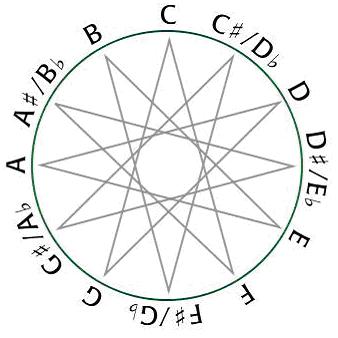
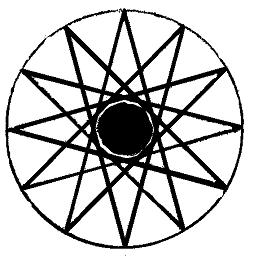
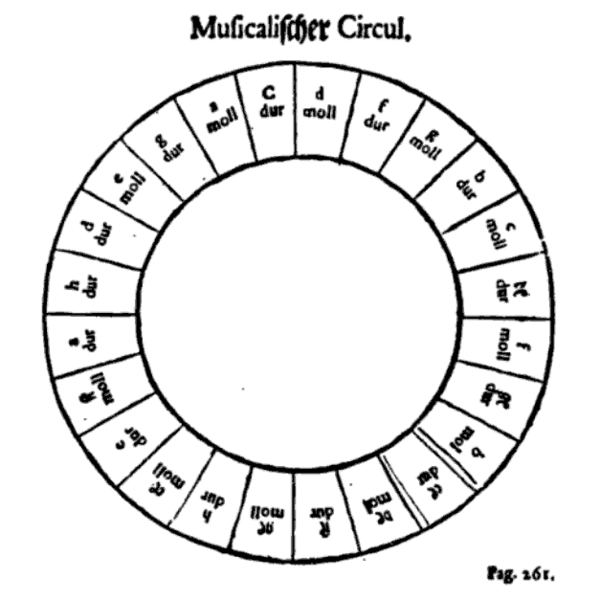
As can be seen above, there is little difference between the two diagrams, and yet Bessler did the right one nearly three hundred years ago, the one on the left was done in 2007. These diagrams illustrate something which is used by musicians today. Johann David Heinichen, 1683-1729, a German musician, introduced the concept known as the ‘circles of fifths’ in 1711 (he called it Quintenzirkel). He was born, raised and got married in Weissenfels, the same place which Bessler moved to after Draschwitz, and close to Obergreisslau. Despite his interest in music, Heinichen practiced law in Weissenfels until 1709. However, he maintained his interest in music and was at the samne time composing operas. In 1710, he published the first edition of his major treatise on the theory of music (Thoroughbass). Bessler lived in Weissenfels in 1714 and had a history of building organs. In 1717 Heinichen became a colleague of Johann Sebastian Bach at the court of Prince Leopold of Anhalt-Cöthen, then went on to be Kapellmeister to the Elector of Saxony. In 1721, Heinichen married in Weissenfels. In between these events his success attracted the attention of Duke Moritz Wilhelm who appointed him to be court composer at Zeitz. As many who have read my biography about Bessler will know, Moritz Wilhelm’s court was home to many learned men who persuaded the great Leibniz to investigate Bessler’s claims. There is a huge amount of correspondence about Bessler between those members of the Court at Zeitz. Now I’m not familiar with the technique but as far as I know, in the illustration above left, the ‘Circle of Fifths’ is an easy way to find out which key a song is in. It tells you how many sharps or flats are in a given key. It is called the ‘Circle of Fifths’ because as you go clockwise, you go up a fifth. Even though I don’t claim to know much about musical theory I understand that you start on, say middle C, then count round the edge of the circle five places which brings you to G. This same technique is applied for any note. The concept of the ‘circle of fifths’ had been around for more than a century and some argue that it can be traced back to China in the 15th century. That may be so, but the Western theory of music stems from work done by Pyathagoras about 2,500 years ago, which has been added to and refined over the intervening years. There is an oral tradition that it had been used for many years as an aid to studying musical theory, passed on from teacher to student. Heinichen attempted to improve the design of the ‘musicalischer circul’, as it was initially called, however the term, ‘circle of fifths’ has survived for the simple reason that it describes ‘fifths’ and is used by counting in fifths around a circle. It is but a simple matter to draw a line to indicate the fifth point or letter from the initial starting point which results in the dodecagram shown above. I’m sure that Bessler, as an organ builder and player, was familiar with this concept and used it for his own purposes, namely as yet another pointer to the number 5. This would appeal to a musician but is seemingly almost unknown outside the world of music. Heinichen is supposed to have coined the term in 1711 and Bessler altered his MT in 1733. They both lived in the same small town at the same time and were both moving within the same group of people. It seems to me to be too much of a coincidence that the term, ‘Circle of Fifths’ which is so apt a description of Bessler’s wheel, should have been coined at that time, in that place, under those circumstances, without Bessler’s knowledge. The diagram he produced as MT 137, looks exactly similar to the modern version above. However ..... Heinichen’s first version of the circle of fifths looked like this!:-
There is little if any similarity to the dodecagram unless you divide the 24 segments into twelve, and for the time being I am forced to admit that, without some evidence of a dodecagram linked to musical theory at that time, I cannot claim the connection is proven, no matter how strikingly coincidental the connection appears to be. For more information about Johann Bessler and to obtain copies of his books with English translations go to www.free-energy.co.uk Copyright © 2009 John Collins.
|
|
|
| NavB[Home] [Bessler's name code] [Apologia Pentagram] [AP chronogram] [AP blanks & dashes] [AP Chapter 55] [Bessler's Initials] [Portrait pentagram] [More 1st portrait] [2nd portrait] [Pentagram in GB] [Golden Mean] [MT 55 pentagram] [MT Nos & letters] [MT 137 part one] [MT 137 part two] [MT 137 part three] [Bessler's Logo] [Drawing no codes] [5th DT Drawing] [Water wheel]wing |